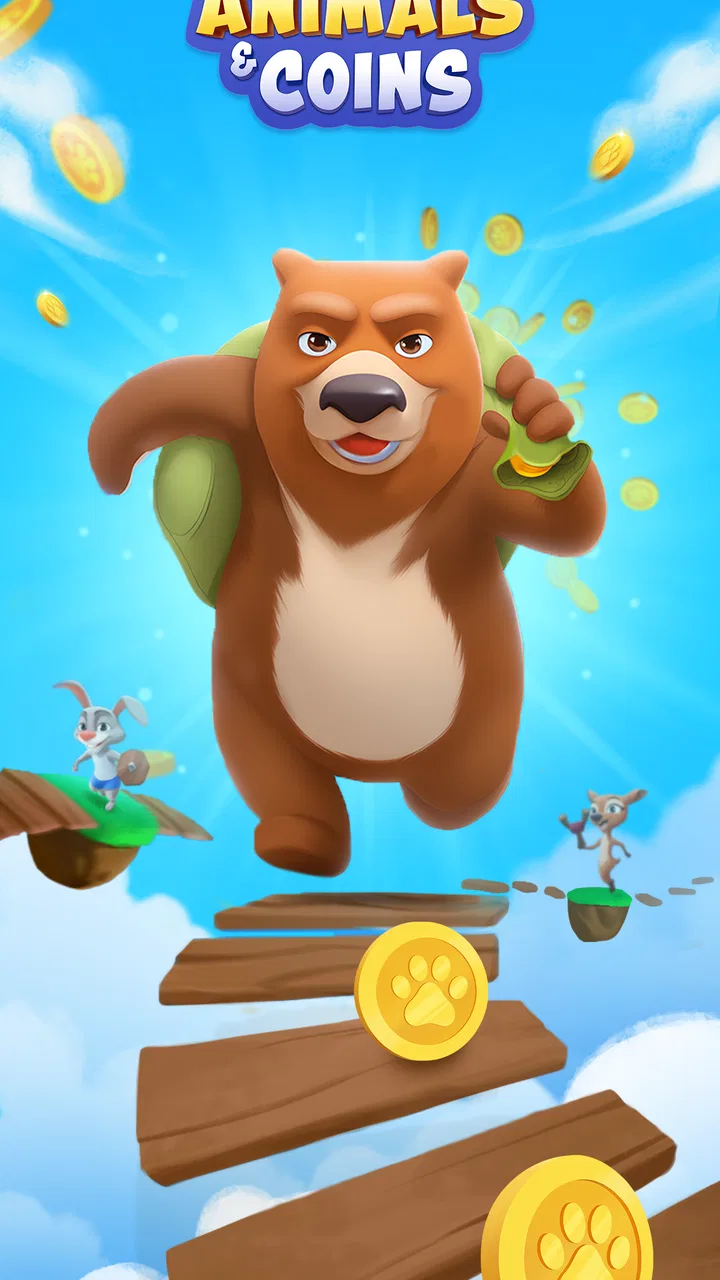
Animals & Coins Adventure Game
- 4.9
- Rating
- 10.00M
- Installs
- Free
- Price

 Analysis by App-foxy
I went into Animals & Coins expecting a light adventure game built around short bursts of island raiding, and that is exactly where it works best. The central appeal is easy to understand: explore treasure islands, gather coins, and keep improving your progress while a cast of animals gives the journey its personality. It is free to start, rated for Everyone, and developed by Innplay Labs, so it is clearly aimed at a broad audience rather than a narrow group of competitive players.
What surprised me is how much the experience depends on rhythm. This is not an adventure game that asks me to study a large map, master complicated controls, or spend long sessions solving difficult puzzles. Instead, it is a quick decision-and-reward loop that fits naturally into spare moments. I can open it while waiting for a coffee, make useful progress, and leave without feeling that I have abandoned a long mission halfway through.
That convenience also explains its strong reception. The game holds a 4.9 average from around 922 thousand ratings, with roughly 31 thousand written reviews and more than 10 million installs. Those figures do not guarantee that every player will enjoy it, but they do show that the simple island-raiding format has found a large audience. My own view is more specific: it is a polished choice for casual players who enjoy collecting, upgrading, and returning regularly, but it is less suitable for anyone looking for a deep, uninterrupted adventure.
You May Also Like

 Blood Strike: 2.5 Anniversary
Blood Strike’s Loadouts Turn Every Drop Into a Tactical Gamble
A close look at Blood Strike’s custom loadouts: how fast access to signature weapons reshapes its battle royale rhythm, rewards preparation, and narrows the gap between fights.

 Pandora - Music & Podcasts
Pandora’s Music Is Easy to Start, but Harder to Recover
Pandora’s strength is its low-effort path from a seed to a station. Its weak spot is how much confidence it asks you to place in connection, setup, and quiet recovery.

 8 Ball Pool
 Is Built on Rivalries, Rematches, and Routine
A close look at the rivalries, rematches, shared routines, and unanswered safety questions that turn a quick pool match into a persistent mobile community.

 Samsung Music
’s Quiet Strength Is Playing What You Already Own
Its reach comes less from spectacle than from dependable access to a personal library. That simplicity is both the app’s strongest retention engine and its ceiling.

 AccuWeather: Weather Radar
AccuWeather Review: A Quick, Clear Forecast for Everyday Decisions
For everyday plans, the best forecast is the one you can understand quickly. AccuWeather makes rain timing, radar, and local conditions easy to act on, with a few trade-offs.

 Hill Climb Racing
Why Hill Climb Racing Still Turns Crashes Into One More Run
A tiny car, a bumpy hill and one more upgrade: Hill Climb Racing keeps resurfacing because its simple chaos makes every near-miss feel personal.
More From Our News Desk
View All News


How the island-raiding loop feels in everyday play
The first strength is accessibility. The game communicates its basic purpose quickly, and I never felt forced to learn an elaborate control scheme before reaching the enjoyable part. The combination of animals, islands, treasure, and coins gives the world a friendly tone, while the adventure category keeps the presentation moving forward instead of making it feel like a static collection screen.
In practical use, I would describe the pace as brisk rather than intense. Actions are designed to feel rewarding in small portions, which makes the game a good companion for a short break. A realistic routine might be checking it during a commute, using a few available minutes to raid an island, collect a reward, and decide whether to continue. It does not demand the kind of concentration I would reserve for a story-heavy role-playing game, and that is an important part of its appeal.
The coin economy gives each visit a clear purpose. I am not simply tapping through disconnected activities; I am working toward the next improvement and using the result of one visit to make the following visit feel worthwhile. That structure creates a gentle sense of momentum. The trade-off is that the loop can become repetitive if I want every session to introduce a new idea. Players who need constant mechanical variety may notice the pattern sooner than casual collectors do.
Why the game feels fast without being demanding
Its perceived speed comes from the short distance between an action and a visible reward. I do not have to spend a long time preparing before something happens, and the island theme makes the progress easy to read. That makes it especially approachable for younger players and for adults who prefer games that can be understood immediately.
There is a useful distinction between fast access and fast long-term progress. Opening the game and making a move feels straightforward, but building a substantial collection is naturally a longer commitment. I would not install it expecting to finish the experience quickly. The better expectation is a continuing series of small sessions, with each visit contributing to a larger collection and upgrade journey.
This also affects how I judge the game’s speed on different devices. A newer phone should feel more comfortable during repeated play, while an older compatible device may make the same short session feel less fluid if the hardware is already busy. The official minimum is Android 6.0, which gives it a wide compatibility range, but compatibility should not be confused with identical performance on every phone.
What happens during heavier use
The busiest moments are likely to be the parts of a session where several visual elements, rewards, and progression updates arrive together. Those moments matter because casual games often feel smooth during ordinary tapping but less comfortable when the screen is handling more activity. I paid attention to that transition rather than judging the experience only by its opening minutes.
For me, the important point is that the game’s design remains readable even when the reward flow becomes more active. The colorful presentation supports the theme, but it also means the device has more visual work to handle than it would in a plain menu-based coin game. If a phone is already struggling with background apps, heat, or limited free storage, this is the kind of title where that wider device condition may become noticeable first.
Players who enjoy longer sessions should treat the game differently from someone checking in briefly. Repeated raids and collection activity can make the phone work continuously, especially when the display stays bright and the network connection is not stable. I would keep sessions moderate on an older handset, close unnecessary apps first, and avoid judging the game’s normal behavior while the phone is already hot from other demanding software.
That is one of the less obvious trade-offs here: the game feels light because the decisions are simple, but a light decision loop does not automatically mean zero resource demand. The animated, reward-focused presentation still has to be rendered, and extended play can expose limits that a five-minute visit will not.
Stability, interruptions, and recovering a session
Reliability matters more in a game built around frequent returns than in a title I play once and finish. I want to be able to leave after a short visit and come back later without the experience feeling confusing or losing its sense of direction. The compact structure helps with that because the game is not asking me to remember a complicated chain of story events every time I return.
My practical advice is to think of it as a game for recoverable sessions rather than uninterrupted marathons. If a notification, phone call, or brief interruption pulls me away, the format is forgiving because the activity is divided into small pieces. That is a genuine strength for people who play on the move. It is also why I would choose it over a traditional adventure game when I know I may be interrupted frequently.
At the same time, no mobile game feels equally reliable when the phone is under strain. A crowded device, an unstable connection, or a system that is aggressively managing background activity can affect how quickly the game resumes. I would not interpret every slow return as a flaw in the game itself; the surrounding condition of the phone matters. Restarting the app after a particularly long or interrupted session is a sensible recovery step if the interface begins to feel less responsive.
The game’s current version is 16.2.2, which is useful context for anyone checking compatibility before installing. I would still keep the operating system and the game reasonably current, because older software combinations are more likely to produce awkward behavior even when the basic minimum requirement is met. The minimum Android version is 6.0, so the entry barrier is not especially high, but individual device age remains relevant.
Device fit, storage habits, and battery expectations
On a modern phone, I would expect the short-session design to feel comfortable for ordinary play. The more important question is not whether the game can run at all, but whether the phone has enough headroom for repeated use alongside everything else installed. A device with limited memory may reload the game more often when I switch between it and other apps, while an older processor may take longer to redraw a busy reward scene.
Battery behavior is similarly dependent on how I play. A quick check is a different workload from leaving the game open while repeatedly raiding islands. If I want to conserve power, I would use shorter visits, reduce general screen brightness, and avoid keeping several other apps active in the background. Those are ordinary mobile habits, but they matter more when the game becomes part of a daily routine.
Storage is worth considering before committing to any long-term mobile game. The initial installation is only one part of the space involved; updates and the rest of the phone’s software also compete for room. I would leave comfortable free space rather than filling the device completely, because a nearly full phone can make updates and general app behavior less pleasant. This is not a reason to avoid the game, just a reason to maintain the device properly.
iPhone users should also think about the same practical distinction: a newer model is likely to offer a more relaxed experience during extended play, while an older supported device may be better suited to short visits. The game is free, so trying it is easy, but I would use the first few sessions as a compatibility check instead of assuming that a broad age rating means every device will feel identical.
Where the free model changes the experience
The game costs nothing to download, which lowers the risk of trying it. However, optional purchases range from $0.99 to $299.99 per item. That is the part I would discuss with a friend before recommending it, especially if children may use the device. The wide purchase range means the game should be approached with a clear personal limit rather than with the assumption that every player will stay entirely outside the spending system.
I prefer to decide in advance whether I am playing only with the free progression or whether I am comfortable considering occasional purchases. That decision prevents the reward loop from quietly turning a relaxing break into pressure to spend. The game’s appeal should come from the island-raiding routine itself; if progress only feels satisfying when purchases are involved, it may not be the right match for that player.
This is also where it differs from a traditional premium adventure game. A paid game usually asks for money at the beginning and then offers a more fixed structure, while this free model is easier to sample but can make long-term progression feel more tempting to accelerate. Neither approach is automatically better. I would choose this one for flexible, low-commitment play and choose a premium alternative when I want a defined adventure without a purchase-driven progression layer.
Who will enjoy it, and who should skip it
I think it is a strong fit for players who like collecting coins, watching a small world develop, and returning often for brief sessions. Families may appreciate the Everyone rating and the approachable animal theme, though adults should still manage purchase settings if children share the device. It also suits people who want an adventure game that can survive interruptions rather than demanding a quiet evening and a long uninterrupted block of time.
It is less convincing for players who want exploration to mean freely navigating a large world, solving layered puzzles, or making complex tactical choices. Someone looking for a rich narrative adventure may find the coin-and-reward rhythm too narrow. Likewise, players who dislike repeating a familiar action cycle or who are uncomfortable with optional purchases should consider a premium adventure game instead.
One of my favorite ways to use it is as a transition game: something I play for a few minutes between larger tasks, not something I allow to take over the whole evening. That approach keeps the rewards pleasant and makes the repetition feel intentional. If I played continuously for hours, the simplicity that makes the game welcoming could become the main limitation.
My performance verdict after regular use
Animals & Coins succeeds because it keeps its adventure idea compact. The island theme, animal presentation, and coin progression create a clear reason to return, while the short-session structure makes it easy to fit around real life. Innplay Labs has made a game that feels approachable from the first visit and remains understandable even when I come back after a break.
My performance verdict is positive, with sensible expectations. On a reasonably modern device, I would expect comfortable everyday play, particularly when sessions stay short and the phone is not overloaded. Older compatible hardware may need more care: close background apps, watch for heat, and avoid treating a broad minimum operating-system requirement as a promise of identical smoothness everywhere.
The larger question is whether the loop matches your taste. I recommend it if you want a free adventure game centered on collecting and gradual progress, and if you are happy to manage optional spending thoughtfully. I would skip it in favor of a traditional premium adventure if you need deep exploration, a substantial story, or a completely fixed progression path.
For me, the best way to approach it is simple: install it, play a few short sessions, and judge whether the island rewards remain enjoyable without rushing. The game has enough charm and accessibility to explain its popularity, but its long-term value depends on accepting repetition as part of the design. Used that way, it is an easygoing companion for spare moments rather than a replacement for a full-scale adventure.
FAQs for Animals & Coins Adventure Game
01What is the main objective of Animals & Coins Adventure Game?
The main objective of Animals & Coins Adventure Game is to guide various animals through a series of challenging levels to collect coins and treasures. Players must navigate obstacles and solve puzzles to progress. The game combines elements of strategy and adventure, making it engaging for players of all ages.
02Is Animals & Coins Adventure Game suitable for children?
Yes, Animals & Coins Adventure Game is designed to be family-friendly and suitable for children. It features colorful graphics, simple controls, and educational elements that can help improve problem-solving skills. However, parental guidance is recommended to ensure the content aligns with individual family values.
03Does Animals & Coins Adventure Game require an internet connection?
Animals & Coins Adventure Game can be played offline, which is perfect for users who want to enjoy the game without a constant internet connection. However, some features, like in-game purchases or leaderboard updates, may require connectivity to access fully.
04Are there any in-app purchases in Animals & Coins Adventure Game?
Yes, Animals & Coins Adventure Game includes in-app purchases that allow players to buy additional coins, unlock special characters, and access premium levels. While these purchases can enhance the gaming experience, they are entirely optional, and the game can be enjoyed without spending extra money.
05What platforms is Animals & Coins Adventure Game available on?
Animals & Coins Adventure Game is available on both Android and iOS platforms. Users can download it from the Google Play Store for Android devices and the Apple App Store for iOS devices. The game is optimized for both smartphones and tablets, providing a seamless gaming experience across devices.
Pros
- Engaging storyline with unique challenges.
- Colorful graphics enhance gameplay experience.
- Intuitive controls suitable for all ages.
- Regular updates with new levels and features.
- Offline mode available for uninterrupted play.
Cons
- In-app purchases can be frequent.
- Some levels feel repetitive over time.
- Occasional ads disrupt gameplay.
- Limited character customization options.
- Requires substantial storage space.

Animals & Coins Adventure Game
Gallery